
Tendonitis vs. Tendinosis: What’s the Difference?
While they sound nearly identical, these two conditions require completely different approaches to healing:
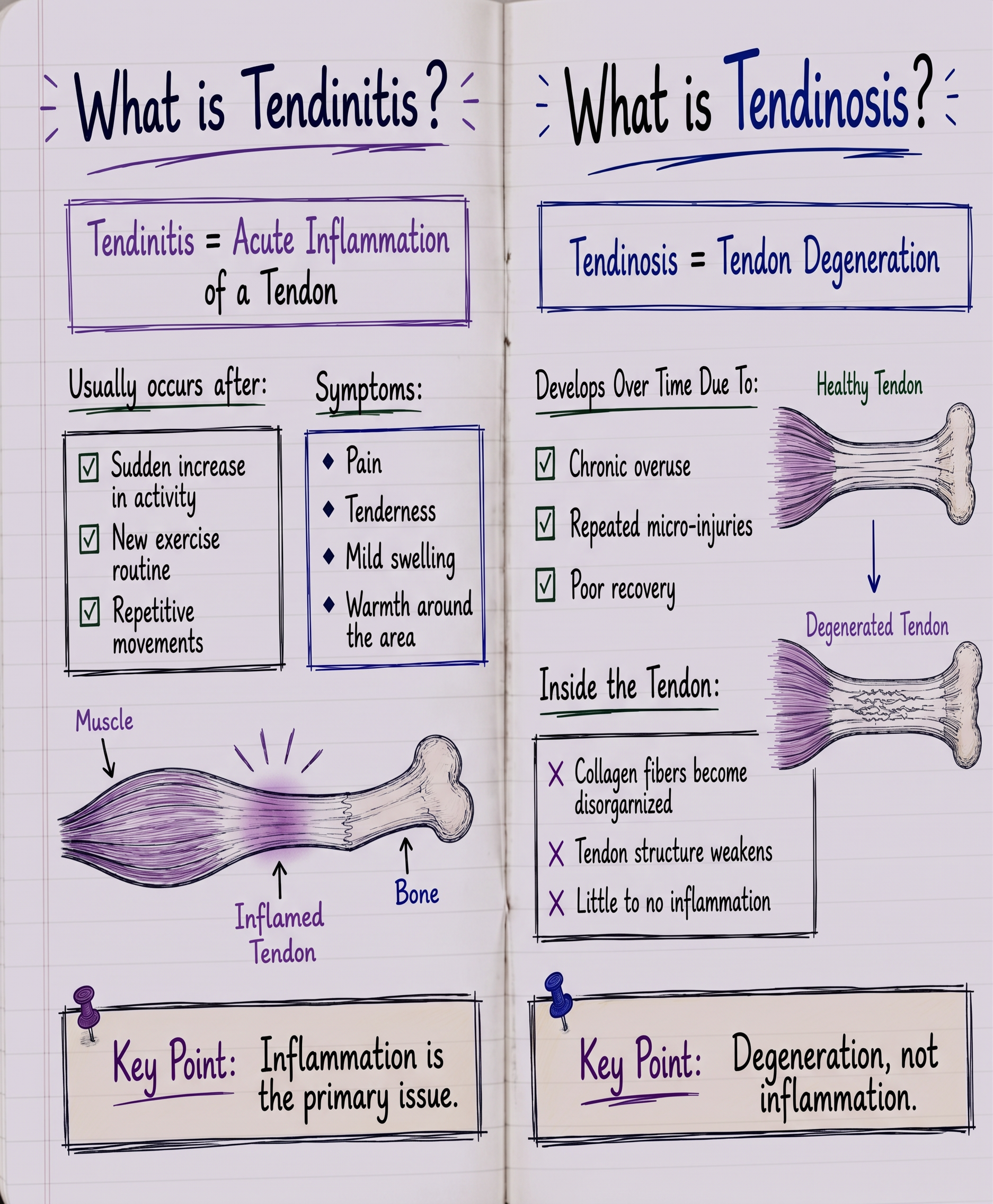
Tendonitis is an acute inflammation of the tendon, usually caused by a sudden strain or temporary overuse. Because it is inflammatory, it typically responds well to short-term rest, ice, and anti-inflammatory measures over a few weeks.
Tendinosis is a chronic, degenerative condition. It occurs when repeated micro-tears and chronic overloading cause the collagen matrix inside the tendon to break down and become disorganized. There is very little to no actual inflammation present. Instead, the tendon becomes structurally weakened, less elastic, and plagued by poor circulation, making it incredibly slow to heal on its own. Because tendinosis is a degenerative cycle rather than an inflammatory one, traditional anti-inflammatory treatments often fail. To heal, the tendon needs to actively remodel its tissue, and that’s where manual therapy comes in.
How Massage Therapy Helps Repair Tendinosis
When treating tendinosis, a massage therapist’s goal shifts from “calming down inflammation” to stimulating a sluggish healing response. Specialized soft tissue work addresses the root structural issues through several key mechanisms:
- Stimulating Collagen Production
Tendinosis leaves the tendon’s collagen fibers looking like a tangled ball of yarn rather than a neat, strong rope. Specialized techniques—such as deep cross-fiber friction—apply localized, precise pressure across the tendon fibers. This targeted manipulation stimulates cellular elements called fibroblasts, triggering the body to produce fresh, new collagen to repair and realign the damaged tissue.
- Breaking Down Adhesions and Scar Tissue
As the body attempts to patch up micro-tears without proper circulation, it often creates messy scar tissue and adhesions. These restrictions bind the tendon to surrounding structures, causing pain and catching sensations during arm movement. Deep tissue massage and myofascial release work to break up these adhesions, restoring a smooth, pain-free tissue glide.
- Reducing “Muscle Guarding” in the Arm and Shoulder
When a tendon is compromised, the brain tells the surrounding muscles to tighten up to protect the joint. This “muscle guarding” means your surrounding muscles are likely locked in a state of high tension, which only pulls harder on the injured tendon. Massage coaxes these overworked muscles to relax, immediately reducing the mechanical stress pulling on the attachment point.
- Improving Blood Supply
Tendons naturally have a very limited blood supply compared to muscles, which is why tendon injuries linger so long. By manually increasing local circulation, massage brings oxygen and vital nutrients directly to the degenerative site, giving the tissue the resources it needs to rebuild.
What to Expect in a Massage Session
Recovery from tendinosis is a gradual process that typically takes anywhere from 3 to 9 months, depending on how long the tissue has been degenerating. In a session focused on tendinosis, treatment generally involves:
- An assessment of your mobility and posture to identify muscular imbalances.
- Broad, warming strokes to relax the surrounding muscles.
- Precise, deeper techniques focused directly on the injured area.
- Guidance on home care to keep the tendon loading safely between appointments.
Don’t let chronic pain hold you back from the activities you love.
Schedule a targeted massage session today, and let’s kickstart your body’s natural healing process.
Northern New Jersey Locations Available
To Schedule a Massage:
Email AtlasBodyReset@pm.me
Text (973) 307-0367